

Scale’s visions are to build trust, take responsibility and go beyond. These visions will help ensure customer success and build a good reputation for the industry. Increased focus on sustainability is part of this picture, and we must ensure that the SDGs are anchored in the organization, achieved and safeguarded. Animal welfare is part of sustainability, or ESG, which stands for Environment, Socialand Governance.
With the major biological challenges facing the industry today, improved animal welfare, measured through lower mortality, better health and more efficient feed utilization, is a prerequisite for ensuring growth, good financial results and a positive reputation. In relation to new regulations and incentive schemes that promote good animal welfare and contribute to positive reputation building, Scale must always be updated and proactive.
The highlights
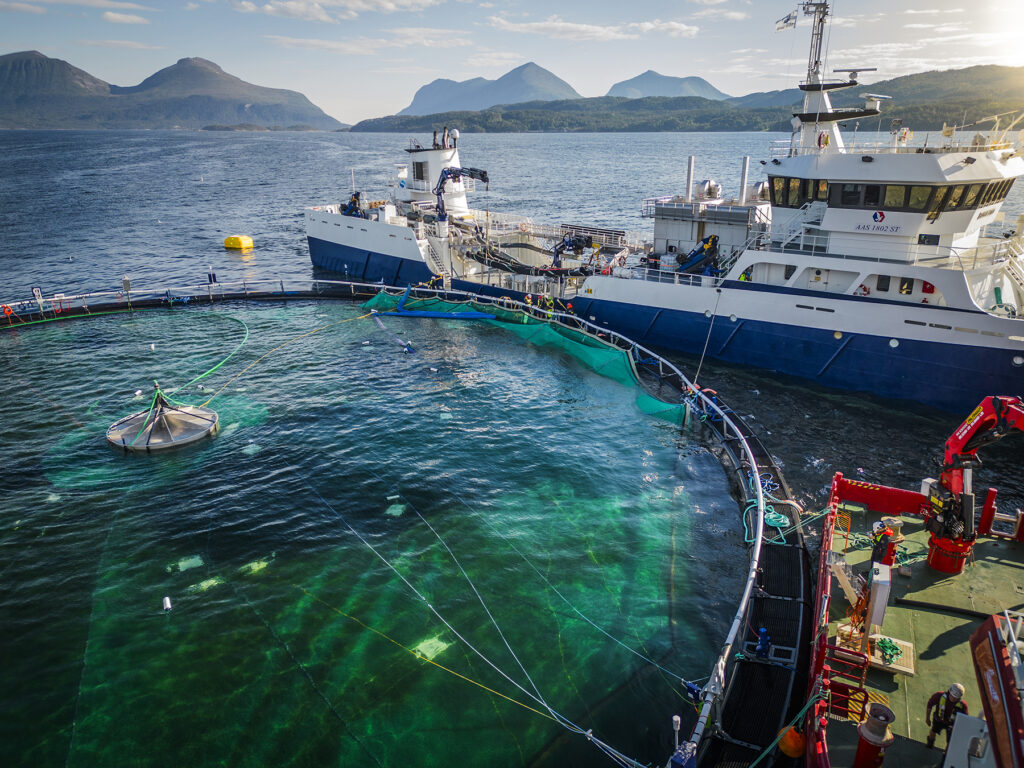
When we remove salmon from its natural environment and process it, handle it, transport it, or keep it trapped in open, closed, partially closed or submerged units, we as an equipment supplier must take responsibility for optimizing animal welfare. In addition to complying with regulatory requirements and guidelines, Scale’s task is to work for continuous product improvement, assist with documentation and make recommendations. We risk assess new technology based on scientific and experiential knowledge, identify measures, document on a large scale, and retain or modify designs. One example is how we work with the development and documentation of Subsea. A biological risk assessment was carried out in advance, with subsequent follow-up and documentation during operation. Among other things, there will be used camera-based observation of swimming behavior (tilt and speed), feeding behavior, use of air dome, outer skin health and general welfare status. In collaboration with the fish farmer, lice infestation and growth are registered. In this way, Scale helps to ensure customer success and positive reputation building by offering thoughtful and economical solutions. We help document that good animal welfare can lead to improved production, earnings and sustainability.
Animal welfare, laws and regulations
According to the Veterinary Institute (VI), animal welfare can be defined in many different ways, but most people agree that “animals are in good welfare when they are in good health, can cope with their surroundings and can perform natural behaviors”. The basis for many countries’ animal welfare laws is The Five Freedoms of Animal Welfare, which are freedom from hunger and thirst, freedom from discomfort, freedom from pain, injury and disease, freedom to exercise normal behavior, and freedom from fear and stress. This is an ideal representation and it is difficult to fulfill everything in practice, but these are still goals that we should try to strive for. There are a number of laws and regulations that we have to comply with that are not optional, either for us or for the animal owner. The most important of these are the Animal Welfare Act, the Aquaculture Operations Regulations (which cover testing at aquaculture facilities), and the Aquaculture Biosafety Regulations (which include provisions on biosafety requirements for the approval of facilities and the movement of aquatic animals).
Other food industry
There are examples from other food industries, such as pork and chicken production, that have taken simple but thoughtful steps to improve animal welfare. They have also shown that the measures do not always have to be costly. One example of a welfare measure implemented in pig production was to give the pigs straw to ruminate on. This way they can exercise natural behavior instead of biting other pigs and causing wounds, infections and great damage. Furthermore, Norsk Kylling was in a negative reputation situation 10 years ago, a situation that is not so different from the one Norwegian salmon production is experiencing today. They made some simple but important moves in animal welfare that quickly improved their production and reputation significantly. Among other things, they switched to a slower-growing chicken breed.
Biological risk assessment and risk matrices
Several reports have been published describing the various welfare indicators for farmed salmon, e.g. from Nofima et al, Welfare indicators for farmed salmon: How to assess and document fish welfare, 2018. In summary, the welfare indicators can be divided into four categories: resources, environment, health and behavior. Together, these will describe the salmon’s welfare status. Based on this, the Institute of Marine Research (IMR) has made a proposal for a risk assessment that is published in the Laksvel report (2022). When we carry out a biological risk assessment of our technology in Scale, we use the four different welfare categories as a starting point, as well as the proposed risk assessment from HI. The Norwegian Food Safety Authority has produced a guide(Guide to fish welfare in the development and use of methods, equipment, technology, etc. in aquaculture, 2020), which we have incorporated and further developed in our quality system. As a tool for use in this work, a risk matrix has been developed that says something about the seriousness and probability of something happening. This risk matrix should not only be used for risk assessment of the technology’s impact on animal welfare, but also reveal the technology’s impact on the external environment and escapes, humans, uptime, economy, reputation, schedule and IT security. The severity of the consequences of the various factors and the likelihood of this happening form the risk level for something to occur, and determine whether measures should be implemented or not.
[vis_kontaktperson_horisontalt user_identifier=”976″]
[vis_kontaktperson_horisontalt user_identifier=”1456″]